
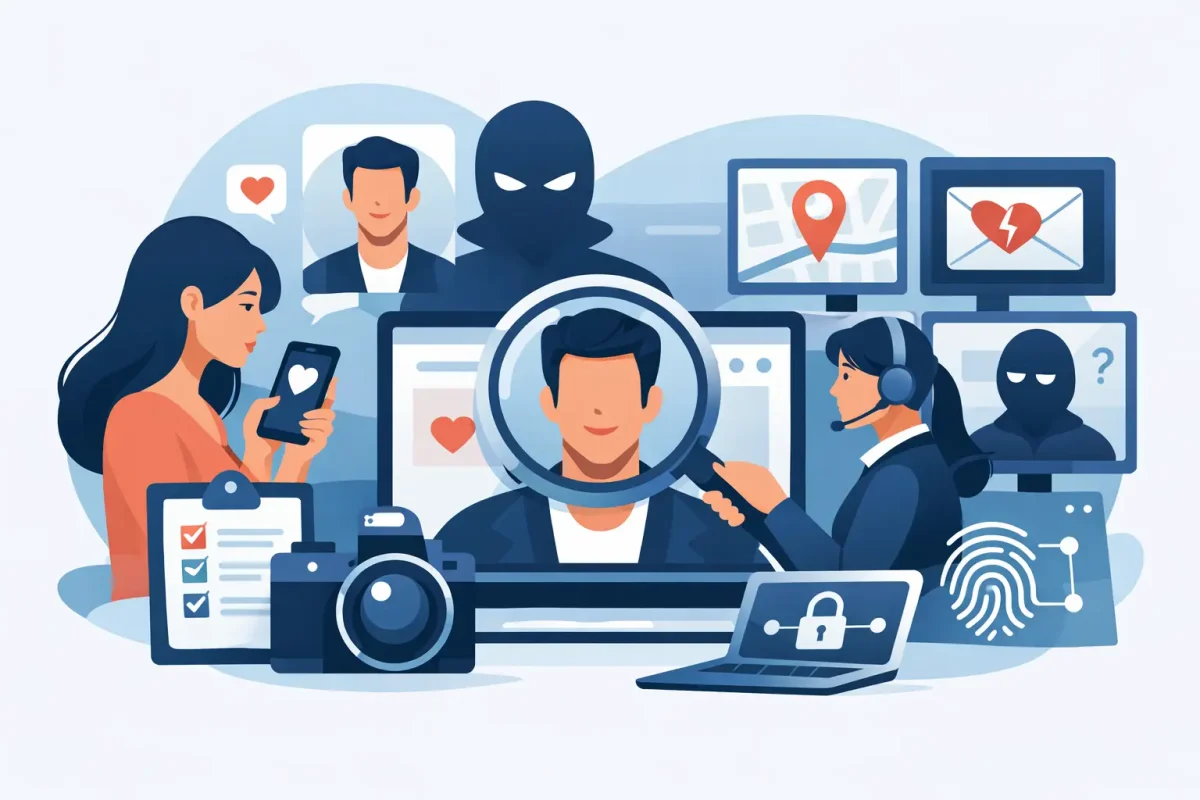
When someone asks for gift cards, wire transfers, crypto, or emergency funds before meeting in person, the situation is no longer just emotional – it is potentially financial fraud. Romance scam investigation services exist for exactly this moment: to verify who is behind the account, preserve digital evidence, trace where money went, and build a factual record that can support recovery efforts, legal action, or both.
This is not the kind of case that responds well to guesswork. Victims are often dealing with a sophisticated fraud pattern that blends social engineering, fake identities, payment laundering, and cross-border activity. By the time concerns become serious, messages may have been deleted, profiles removed, and funds moved through multiple channels. A professional investigation brings structure to a situation that usually feels chaotic.
What romance scam investigation services actually do
A credible romance scam investigation is not limited to checking whether a profile picture is stolen. That can be part of the process, but the real work is broader and more forensic. Investigators analyze communication patterns, identify inconsistencies in the subject’s claims, examine payment instructions, trace digital accounts, and document evidence in a way that is usable outside a casual online search.
In many matters, the core questions are practical. Is the person real? Are multiple aliases involved? Did the scammer use a money mule, a fake investment platform, or a cryptocurrency wallet? Were bank transfers routed through shell accounts? Is there enough evidence to support a bank dispute, law enforcement report, civil claim, or attorney review? Those questions require methodology, not intuition.
Advanced firms also work beyond surface-level identity checks. They may use AI-driven analysis to detect behavioral anomalies across messages, map infrastructure tied to email addresses or domains, and correlate digital artifacts that point to organized scam networks rather than a lone individual. When cryptocurrency is involved, blockchain forensics becomes critical. Wallet movements, exchange exposure, and transaction clustering can reveal patterns that an ordinary victim cannot see.
Why victims often wait too long to seek help
Romance scams are effective because they are designed to override skepticism. The scammer builds trust first, then urgency. A medical emergency, frozen account, military deployment issue, customs problem, investment opportunity, or travel crisis creates pressure to act quickly. By the time the story breaks down, the victim may feel embarrassed, defensive, or unsure whether a private investigator can actually help.
That delay matters. Digital evidence degrades fast. Messaging apps get wiped. Social profiles disappear. Payment intermediaries close accounts. Cryptocurrency gets forwarded through multiple wallets. Banks and exchanges also work on timelines, and early reporting can make a significant difference even when recovery is not guaranteed.
There is also a legal reason not to wait. If you may need to present evidence to law enforcement, counsel, financial institutions, or a court, the quality of collection matters. Screenshots taken out of context or incomplete transaction records can weaken a case. A structured investigation helps preserve chronology, identify sources, and reduce evidentiary gaps.
The signs that call for romance scam investigation services
Some cases are obvious. Others sit in a gray area where the victim knows something is off but cannot prove it. That is often the point at which romance scam investigation services provide the most value.
Common triggers include repeated requests for money, refusal to meet live in a verifiable way, inconsistent job or location details, sudden crypto investment advice, requests to move the conversation off-platform, and documents that look official but cannot be independently verified. Another major warning sign is payment routing. If funds are sent to a third party, to multiple bank accounts, through peer-to-peer apps, or into cryptocurrency wallets unrelated to the supposed partner, the risk profile changes sharply.
A professional investigation is also appropriate when family members suspect a loved one is being exploited but cannot persuade them with informal research alone. Objective findings often carry more weight than personal warnings.
How a professional investigation usually works
The first phase is case intake and evidence preservation. Investigators gather the known facts, identify all communication channels, secure transaction records, and establish a timeline. This step sounds basic, but it shapes everything that follows. A case built on fragments tends to miss the key trail.
The second phase is subject and infrastructure analysis. Depending on the facts, this can include identity verification, metadata review, account pattern analysis, image and persona assessment, IP-related intelligence, domain research, and open-source intelligence correlation. If the scam involved financial transfers, forensic review extends to bank details, payment processors, exchange deposits, wallet addresses, and movement patterns.
The third phase is reporting. This is where experienced firms distinguish themselves. Clients do not just need raw findings. They need organized, understandable, and legally conscious reporting that explains what was identified, what remains uncertain, and what actions are now realistic. That may include recommendations for reporting to a bank, presenting materials to law enforcement, consulting counsel, or pursuing parallel asset tracing.
Crypto, wire transfers, and the recovery question
Many romance scams now overlap with investment fraud. A scammer builds an emotional relationship, then introduces a trading platform, a mining opportunity, or a private crypto strategy. On the surface, it looks like romance. Operationally, it may be a pig-butchering scheme with financial layers designed to maximize extraction.
This matters because the investigative path changes based on payment method. Bank wires, card payments, peer-to-peer apps, and cryptocurrency all create different evidentiary trails and different opportunities for intervention. A wire may involve beneficiary analysis and account mapping. Crypto requires wallet tracing, exchange attribution, and transaction path analysis. Gift cards and cash transfers are usually harder, but even then, the communication pattern and supporting digital evidence may still identify network behavior.
Recovery is the question most clients ask first, and the honest answer is that it depends. Some funds are recoverable, some are traceable but not realistically recoverable, and some cases produce strong intelligence that is more useful for legal positioning than immediate reimbursement. A serious investigator should be direct about that distinction. Promising guaranteed recovery in a romance scam case is usually a red flag.
What to look for in romance scam investigation services
Not all investigators are equipped for digital fraud. Traditional surveillance skills do not automatically translate to cryptocurrency tracing, payment analysis, or cross-border cyber-enabled fraud. If money moved electronically, the investigator should be able to explain how they handle digital evidence, financial tracing, and reporting standards.
Look for a service that combines human investigative judgment with technical capability. AI-driven analysis can accelerate pattern detection and anomaly review, but it only adds value when paired with manual forensic interpretation. You also want clarity on confidentiality, evidence handling, and whether the final work product is suitable for attorneys, law enforcement, or financial institutions.
The best providers are measured in their claims. They explain the scope, define the likely outputs, and separate identity verification from financial tracing and recovery support. That transparency is not a sales detail. It is part of competent case management.
When the goal is proof, not just peace of mind
Some clients contact an investigator because they need certainty before sending more money. Others already know they were scammed and need formal evidence. Those are different objectives, and the investigation should match the purpose.
If the priority is verification, the process may focus on identity inconsistencies, fake persona indicators, and source validation. If the priority is recovery support or litigation, the work must go further into transaction analysis, documentary evidence, and structured reporting. In higher-stakes matters, especially those involving businesses, estates, or large losses, a forensic standard matters more than a quick answer.
That is where a specialized firm such as Lunar Detective can add real value. Cases involving crypto, complex payment paths, or cross-border fraud need more than general suspicion. They need disciplined evidence collection, digital tracing, and reporting that stands up under scrutiny.
If you suspect a romance scam, the next move should be practical. Stop sending money, preserve every message and receipt, avoid confronting the scammer in a way that tips them off, and get the evidence reviewed before more data disappears. A fast, well-scoped investigation cannot erase what happened, but it can replace confusion with facts – and facts are what every next step depends on.
