
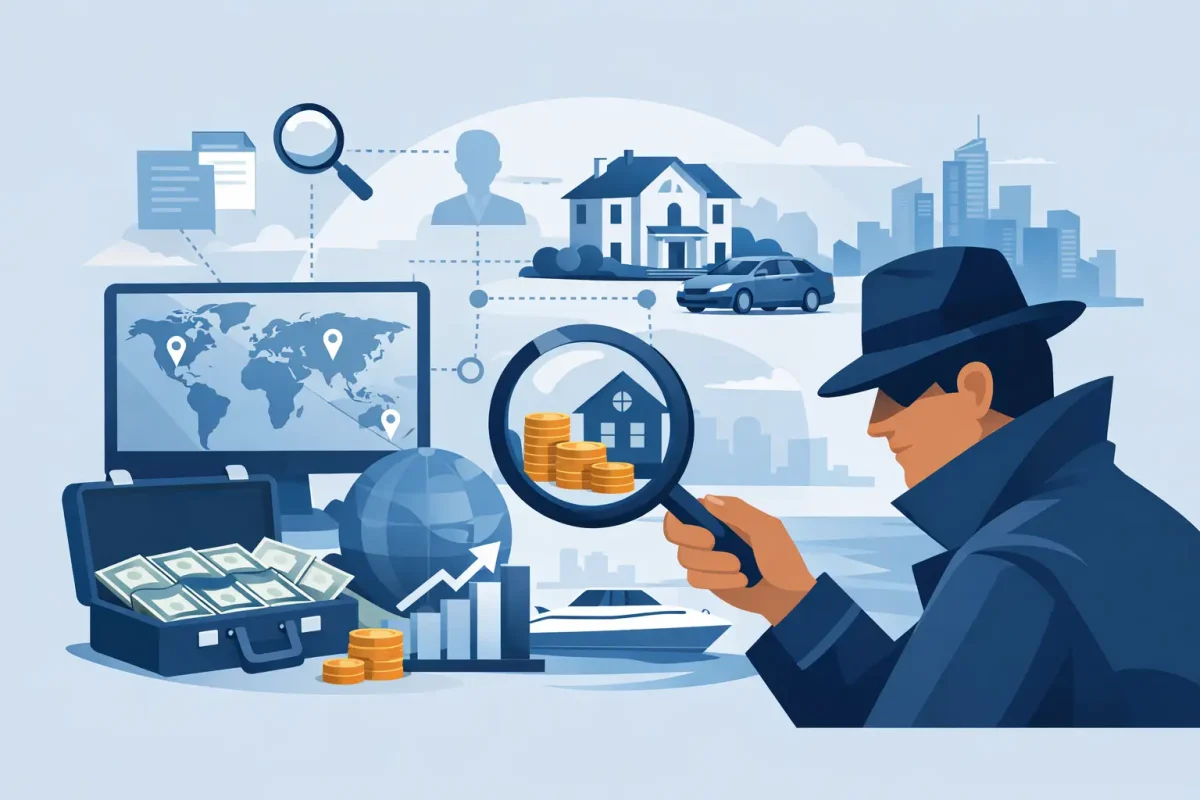
When money disappears, the problem is rarely just missing funds. It is missing context – where the assets went, who controls them, how they were moved, and whether the trail will still hold up when a lawyer, insurer, court, or regulator looks at the evidence. That is where an asset tracing private investigator becomes valuable. The right investigator does not guess. They reconstruct movement, identify patterns, and turn scattered financial clues into actionable intelligence.
What an asset tracing private investigator actually does
An asset tracing private investigator works to locate, map, and document assets that may be hidden, diverted, transferred through intermediaries, or disguised across multiple platforms and jurisdictions. In practical terms, that can mean tracing bank transfers, reviewing corporate records, identifying beneficial ownership, following cryptocurrency transactions, examining public filings, and analyzing digital evidence tied to fraud or concealment.
This work is often misunderstood as a simple search for bank accounts or property records. In reality, serious asset tracing is an investigative process. It combines financial analysis, open-source intelligence, records research, digital forensics, and structured reporting. The goal is not just to find a name attached to an asset. The goal is to establish a credible chain of information that explains control, movement, and relevance.
That distinction matters when the stakes are high. If you are dealing with fraud, divorce-related concealment, business partner disputes, judgment enforcement, embezzlement, or cross-border scam activity, weak findings can waste time and damage legal strategy. Strong findings help counsel act faster and with more precision.
Why asset tracing is more complex than it looks
People trying to hide assets rarely leave them in obvious places. Funds may move through shell companies, nominee structures, relatives, layered transfers, digital wallets, payment processors, or foreign accounts. Even when assets are not intentionally hidden, the ownership trail can still be fragmented across banking systems, corporate registrations, real estate filings, litigation records, and online activity.
Digital fraud has made the problem harder. A scam victim may know the wallet address that received crypto, the exchange used for conversion, and the bank account that sent the original wire – but those pieces do not automatically connect themselves. They need analysis. The same applies in corporate cases where internal theft is spread across reimbursements, false vendors, mule accounts, and personal purchases designed to look ordinary.
An effective investigation usually starts with a central question: are you trying to locate assets for recovery, prove concealment, assess solvency, or support litigation? The answer shapes the methods. A pre-litigation matter may focus on speed and intelligence gathering. A case already heading to court may require tighter evidentiary standards, cleaner documentation, and coordination with counsel.
How investigators trace assets in modern cases
A professional asset tracing engagement usually begins by building a working profile of the subject and the transaction environment around them. That means reviewing known identifiers, financial events, associated entities, addresses, account details, wallet addresses, communications, and prior business activity. The purpose is to create a map before chasing fragments.
From there, the investigation moves into correlation. Public records may reveal property ownership, liens, corporate affiliations, and legal disputes. Digital-forensic review can surface metadata, payment instructions, account screenshots, email headers, or device artifacts. Blockchain analysis can identify transaction flows, clustering patterns, exchange exposure, and movement between wallets. Financial analysis can highlight anomalies such as round-dollar transfers, repeated intermediary use, timing patterns, or sudden shifts in behavior after a claim, complaint, or demand.
This is where technology helps, but only if used properly. AI-driven analysis can accelerate pattern detection across large datasets, flag unusual relationships, and surface records that deserve human review. It does not replace judgment. False positives are common in raw data work, and identity confusion can derail an investigation if records are matched carelessly. Skilled investigators use automation to narrow the field, then apply manual verification before making conclusions.
At Lunar Detective, that combination of technical analysis and forensic review is central to handling fraud and hidden-asset cases that cross from traditional finance into crypto, cyber-enabled scams, and international movement of funds.
What types of assets can be traced
The answer depends on the available facts, the jurisdiction, and the degree of concealment. Traditional targets include bank accounts, brokerage accounts, business interests, real estate, vehicles, equipment, and high-value personal property. In commercial matters, investigators may also look at receivables, vendor relationships, merchant processing activity, and assets held through affiliated companies.
Digital assets have become a major category. Cryptocurrency can sometimes be traced far more effectively than clients expect, especially when transfers occurred on public blockchains and there is a path toward exchange identification. But crypto tracing has limits. If funds moved through privacy tools, chain-hopping services, peer-to-peer transfers, or offshore platforms with minimal compliance, the trail may narrow without fully resolving. That does not make the work useless. Even partial tracing can identify counterparties, timing, exposure points, and leverage for legal or regulatory action.
Not every case ends with a recoverable bank account or frozen asset. Sometimes the real value is establishing where funds likely went, who benefited, and whether the subject appears to have collectible resources. That can change whether a client pursues litigation, settlement, enforcement, or a fraud report.
When hiring an asset tracing private investigator makes sense
The strongest cases usually involve a clear financial event and a credible need for evidence. If you sent a wire to a fraudulent recipient, suspect a spouse or partner is concealing property, believe a company insider diverted funds, or need to evaluate a defendant before filing suit, asset tracing can provide direction before more money is spent.
It is also useful when legal professionals need support beyond standard discovery tools. A private investigator can often help organize leads, verify identities, connect public and digital records, and produce reporting that gives counsel a clearer target. In scam matters, speed matters because funds can move rapidly across platforms. In business disputes, early tracing may show whether assets are being dissipated ahead of judgment.
What matters most is timing and expectations. The earlier the investigation begins, the better the chance of preserving useful records and identifying movement before it becomes more layered. But clients should also understand that asset tracing is not magic. Results depend on the quality of starting information, the sophistication of concealment, and whether the asset trail intersects with accessible records or compliant institutions.
What to look for before you hire
Not every investigator is equipped for financial and digital asset work. Many can perform basic records searches. Far fewer can analyze transaction behavior, trace crypto exposure, assess beneficial ownership structures, or prepare reporting suitable for attorneys and recovery efforts.
Look for technical competence, legal-process awareness, and a disciplined methodology. An investigator should be able to explain how they validate information, what sources they use, where the limits are, and how findings will be documented. Confidentiality is essential, but so is transparency. You should know what can reasonably be pursued, what may require legal process, and what evidence is intelligence versus evidence ready for formal use.
Cross-border cases deserve extra caution. International asset tracing often involves jurisdictional friction, delayed records, nominee entities, and differing disclosure rules. Firms that understand digital trails, financial fraud patterns, and litigation support are usually better positioned than generalist investigators.
The real outcome clients should expect
The best outcome is not simply finding an asset. It is obtaining a defensible picture of financial reality. That may include identifying hidden property, tracing diverted funds, linking wallets to service providers, exposing related entities, or showing that a target has fewer recoverable resources than claimed. Each of those outcomes helps a client make a smarter decision.
For individuals, that can mean understanding whether a recovery effort is viable. For businesses, it can mean documenting employee theft or partner misconduct before losses grow. For attorneys, it can mean receiving structured intelligence that sharpens pleadings, enforcement strategy, or settlement posture.
Asset tracing works best when it is treated as part of a larger response, not a last-minute search after every trail has gone cold. If funds have moved, records are scattered, or a subject appears to be hiding ownership behind layers of digital and corporate activity, the right investigation can replace uncertainty with direction. In high-stakes matters, that clarity is often the first real step toward control.
