
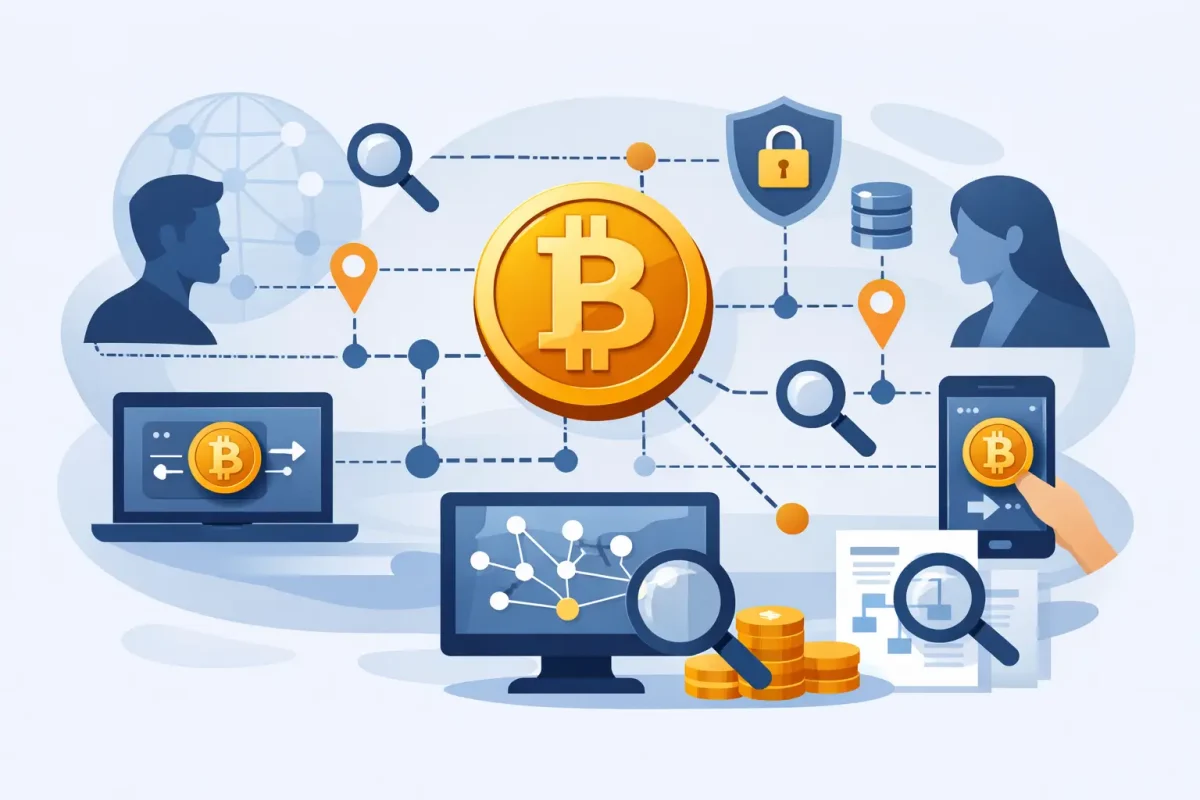
A wallet address can look anonymous at first glance. For scam victims, attorneys, and businesses facing financial fraud, that appearance is often the first obstacle. Bitcoin transaction tracing is the process of following cryptocurrency movement across the blockchain, identifying patterns, linking wallet activity, and turning raw transaction data into usable investigative intelligence.
That matters because Bitcoin is not invisible. The blockchain is public, permanent, and highly structured. What it does not provide on its own is identity. The investigative challenge is bridging the gap between public transaction records and the real people, services, or entities behind them. That requires more than viewing a block explorer. It calls for blockchain forensics, attribution analysis, anomaly detection, and evidence handling that can stand up in a legal or recovery context.
What bitcoin transaction tracing actually shows
At a basic level, bitcoin transaction tracing maps the path of funds from one address to another. Investigators review transaction hashes, wallet clusters, change addresses, timing patterns, transaction amounts, and interactions with known services such as exchanges, payment processors, gambling platforms, mixers, and merchant tools.
The blockchain can show where funds moved, when they moved, how they were split, and whether they converged with other wallets. In many cases, it can also show whether the assets ultimately reached a centralized exchange or another service that may hold customer records. That is often the key turning point in a fraud investigation.
Still, tracing does not always produce a name on day one. Sometimes it produces a higher-value result first: a wallet cluster tied to a scam operation, a route into an exchange, a pattern consistent with laundering, or evidence that funds remain active rather than lost. Those findings can support legal strategy, reporting to law enforcement, civil action, or a recovery effort.
How bitcoin transaction tracing works in real investigations
Professional tracing starts with evidence collection. That includes wallet addresses, transaction IDs, screenshots, chat logs, exchange statements, payment confirmations, emails, and device data where available. The goal is to establish an accurate starting point before any tracing begins. A single digit error in a wallet address can send an investigation in the wrong direction.
From there, analysts reconstruct the transaction flow. They examine how the suspect wallet received funds, whether it pooled victim deposits, and where those funds were sent next. Blockchain analytics tools help detect wallet clustering and interactions with known entities, but software alone is not enough. Human review is needed to separate meaningful patterns from noise, especially when a scammer uses multiple hops to create confusion.
A common mistake is assuming that every transfer after the first one is equally important. In reality, some transactions matter far more than others. Investigators look for choke points – addresses or services where control, custody, or attribution becomes more likely. For example, if funds move through several private wallets and then arrive at a regulated exchange, the analysis shifts from abstract tracing to potential identification and evidence development.
This is where forensic reporting becomes critical. A tracing result is only useful if it can be documented clearly, chronologically, and in a way that non-technical parties can understand. Victims need clarity. Attorneys need organized evidence. Courts and law enforcement need a report that explains what was observed, how it was verified, and what the findings do and do not prove.
Why tracing Bitcoin is possible despite the anonymity myth
Bitcoin is often described as anonymous, but pseudonymous is the more accurate term. Wallet addresses do not display a legal name, yet every transaction is visible on a public ledger. Once one address is tied to a person or service, related activity can become much easier to analyze.
That is why scammers often move funds quickly. They know the blockchain creates a permanent trail. Speed, however, does not erase that trail. It only increases the need for fast investigative action.
The stronger cases often combine blockchain data with off-chain evidence. Exchange records, IP logs, account registration details, device metadata, social engineering messages, and banking activity can all reinforce the tracing analysis. On its own, the blockchain shows movement. Combined with external evidence, it can support attribution.
Limits and trade-offs in bitcoin transaction tracing
Tracing is powerful, but it is not magic. There are limits, and serious investigators should be direct about them.
If funds pass through privacy-enhancing services, cross-chain bridges, mixers, or uncooperative offshore platforms, attribution becomes harder. Not impossible in every case, but harder. Some pathways can still be analyzed through pattern recognition and service exposure analysis, while others may require subpoenas, court orders, or law enforcement collaboration.
Time also matters. The longer a victim waits, the more opportunities a scammer has to fragment funds, move them across services, or cash out. That does not mean older cases are hopeless. It means expectations must be realistic. Some investigations aim at recovery support. Others focus on identifying responsible parties, documenting losses, exposing networks, or supporting litigation.
There is also a difference between tracing funds and recovering them. Tracing tells you where the assets went and possibly who controlled part of the path. Recovery depends on jurisdiction, asset status, custodial involvement, legal process, and whether the receiving platform will cooperate. Many victims are misled by services that promise guaranteed recovery simply because they can see a transaction on-chain. Serious firms do not make that promise.
When bitcoin transaction tracing is most useful
Tracing is especially valuable in fraud matters where the victim knows they sent Bitcoin but does not know who ultimately received it. That includes investment scams, romance scams, impersonation fraud, fake recovery scams, vendor fraud, internal theft, and asset concealment disputes.
For law firms, tracing can help establish transaction chronology, identify asset movement patterns, and support claims involving dissipation, fraud, or hidden holdings. For businesses, it can expose payment diversion schemes or suspicious wallet activity tied to employees, counterparties, or cyber incidents. For individuals, it often provides the first clear picture of what happened after the transfer left their control.
In many engagements, the most valuable outcome is not a single wallet label. It is a structured map of the network: source wallets, intermediary hops, high-risk services, exposure to exchanges, and indicators of coordinated activity. That broader picture can guide next steps more effectively than a simple screenshot of a transaction page.
What to look for in a tracing provider
Not every crypto tracing service operates at the same level. Some providers produce little more than public blockchain screenshots packaged as a report. Others combine AI-driven analysis with manual forensic review, attribution research, evidence preservation, and litigation-aware documentation.
The difference shows up quickly. A credible provider should explain scope, methodology, limitations, and likely next steps. They should distinguish between probable attribution and confirmed identity. They should understand chain of custody, documentation standards, and how to preserve findings for attorneys, regulators, or law enforcement.
This is also where discretion matters. Fraud victims are often dealing with financial loss, embarrassment, family pressure, or business exposure at the same time. The right investigative team handles communication carefully, moves quickly, and avoids overstating what the evidence can support. That balance of technical depth and restraint is what turns tracing into something useful.
At firms such as Lunar Detective, that work typically sits at the intersection of blockchain forensics, financial investigation, and evidence-based reporting. For clients, the practical value is simple: clear findings, actionable intelligence, and a process built for real-world fraud matters rather than theoretical blockchain analysis.
The first steps after suspected crypto fraud
If you believe you sent Bitcoin to a scammer or fraudulent counterparty, preserve everything immediately. Save wallet addresses, transaction IDs, exchange receipts, account statements, chats, emails, website screenshots, and any proof of how the payment was requested. Do not alter devices or delete conversations.
Then act quickly. Early tracing can identify whether funds are still moving, whether they reached a known service, and whether the case is better suited for exchange escalation, legal counsel, law enforcement referral, or broader financial investigation. Delay reduces options.
Bitcoin transaction tracing works best when it is treated as part of a larger investigative strategy, not a standalone curiosity. The blockchain can reveal a great deal, but only if someone knows how to read it, verify it, and connect it to the evidence that matters. When financial harm is real, clarity is not just informative – it is the first step toward a response.
