
SWIFT MT103 Wire Recalls: Emergency Steps to Stop and Recover Fraudulent Bank Transfers
Discovering that a wire transfer was sent to a fraudulent bank account triggers an immediate race against time. Whether it stems from a Business Email Compromise (BEC) scheme, real estate escrow fraud, or a synthetic investment platform, victims face the exact same wall of resistance: their sending bank states that “the funds have already left the building” and there is nothing more they can do.
Understanding the technical mechanics of the international payment network specifically the SWIFT MT103 document (and its modern ISO 20022 equivalent, pacs.008) is the difference between recovering stolen capital and watching it disappear into offshore accounts.
This guide breaks down how a SWIFT MT103 wire recall works under emergency protocols, how automated stop-and-recall mechanisms function across correspondent networks, and the exact steps to freeze stolen funds.
What Is a SWIFT MT103 Document? (And What It Is Not)
The Technical Role of the MT103 in International Transfers
A SWIFT MT103 is a standardized payment instruction message used to transmit customer credit transfer details between sending, correspondent, and receiving financial institutions.
When analyzing wire fraud, investigators evaluate several critical fields within the document:
-
Field 20 (Transaction Reference Number / UETR): The unique 36-character Unique End-to-End Transaction Reference that tracks the wire across global correspondent banks.
-
Field 32A (Value Date, Currency, & Interbank Amount): Specifies the exact execution timestamp and settlement amount.
-
Field 50K/A (Ordering Customer): The legal details of the sending entity.
-
Field 59 (Beneficiary Account Details): The fraudulent receiving account number, IBAN, and legal name designated by the perpetrator.
Clarifying Misconceptions: Document Proof vs. Cash Settlement
A common misconception among fraud victims is assuming that possessing an MT103 PDF proves the funds are safely settled. An MT103 is an audit log and transaction instruction it is not stored cash.
While static legacy PDFs can be forged or altered by cybercriminals, modern SWIFT gpi (Global Payments Innovation) integration allows financial institutions and forensic investigators to monitor real-time transaction movements using the UETR tracker.
How a SWIFT Wire Recall Works in Fraud Cases
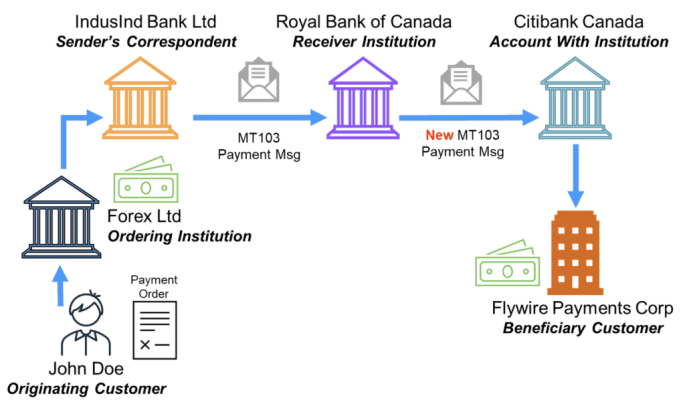
[Sending Bank] ---> Sends MT192 / gSTOP Signal ---> [Correspondent Bank] ---> Intercepts / Freezes ---> [Beneficiary Bank]
The Emergency Protocol: SWIFT MT192 / MT292 Requests
When a sender notifies their bank of a fraudulent transaction, standard customer service representatives cannot simply “pull back” the money. Instead, the sending bank’s wire compliance operations team must issue a formal cancellation request across the SWIFT network:
-
MT192 (Request for Cancellation): Transmitted by the sending bank to notify downstream correspondent institutions to halt the transfer.
-
MT292 (Answers to Request for Cancellation): The formal status reply from the receiving institution confirming whether funds were successfully intercepted or already credited.
The Critical 24 to 48-Hour Window: The first 24 to 48 hours post-transmission represent the critical threshold. If the receiving bank processes incoming transfers automatically, funds land in the beneficiary account immediately. If intercepted while in transit via correspondent networks, recovery probabilities rise significantly.
SWIFT gpi Stop and Recall (gSTOP)
Modern international transfers utilize SWIFT gpi Stop and Recall services. If an initiating bank flags a payment as fraudulent shortly after dispatch, a digital gSTOP directive propagates through the cloud tracker. This automatically halts payment processing at any participating intermediary bank before credit to the beneficiary account takes place.
Immediate 4-Step Action Plan When Wire Fraud Is Discovered
Step 1: Demand the MT103 & Request an Immediate SWIFT MT192 Recall
Contact your bank’s dedicated Wire Fraud / Anti-Money Laundering (AML) Department immediately do not rely solely on frontline branch staff.
-
Demand a complete copy of the SWIFT MT103 record containing the UETR number.
-
Formally request that the compliance officer submit an urgent SWIFT MT192 / gSTOP recall message explicitly tagged with “Fraudulent Activity – Unauthorized Withdrawal”.
Step 2: Request an Administrative Fraud Freeze at the Receiving Bank
The sending bank’s risk department should issue an urgent hold request directly to the receiving bank’s Fraud Operations group. Under international KYC (Know Your Customer) and AML regulations, receiving institutions that fail to act on credible fraud notices risk regulatory sanctions or civil liability.
Step 3: File Immediate Law Enforcement & Regulatory Reports
Formal documentation is required to compel receiving banks to hold suspicious funds long-term:
-
FBI IC3 (Internet Crime Complaint Center): Submit a report immediately to trigger the Financial Fraud Action Chain (RAT – Recovery Asset Team) if the wire exceeds $50,000 and involved international banking channels.
-
Local Law Enforcement Complaint: Obtain a police report containing the formal case file number.
Step 4: Engage Independent Financial Forensics & Legal Counsel
If the receiving bank refuses to return funds without a court order, engaging specialized financial investigators becomes essential.
At Lunar Detectives, our forensic team analyzes MT103 metadata, extracts email header evidence from Business Email Compromise schemes, traces beneficiary account networks, and prepares court-admissible forensic packages. These reports assist legal counsel in obtaining emergency civil freezing orders (such as Mareva injunctions or pre-judgment attachments) before perpetrators can drain the account.
Red Flags: Spotting SWIFT MT103 Recovery Scams
Fraud victims are heavily targeted by secondary “recovery scams.” Recognizing these predatory tactics protects against secondary financial losses:
-
The “SWIFT Server Unlocking” Fallacy: Fraudulent actors often claim that wire funds are “stuck on a SWIFT server” and demand “tax clearances,” “anti-terrorist certificate fees,” or “MT103 activation payments” to release the funds.
-
The Reality: SWIFT is a secure messaging protocol network, not a bank. SWIFT does not hold money, nor does it charge end-users “activation fees” to process recalls.
-
No Upfront Percentage Guarantees: Legitimate forensic firms operate under transparent, fixed investigative retainers and clear legal standards. They never claim to “hack the SWIFT system” or guarantee automatic fund returns.
Frequently Asked Questions (FAQ)
Can a bank reverse a wire transfer once it has landed in the receiving account?
Once funds settle into a beneficiary account, the receiving bank generally cannot debit that account without the account holder’s consent or a formal legal directive. Reversal requires a court order (such as a freeze or forfeiture order), intervention by law enforcement compliance, or the consent of the account owner.
How long does a SWIFT MT103 wire recall take to process?
Status responses via SWIFT gpi or MT192 cancellation requests typically arrive within 24 to 72 hours. However, the actual return of held capital depends on bank compliance reviews, anti-money laundering investigations, and jurisdictional legal processes, which can extend from several weeks to months.
How do I obtain a copy of my MT103 document?
Only the ordering sender or account holder can request the official MT103 record from the sending bank. Contact your bank’s international wire transfers department and request the “full SWIFT message confirmation printout” for your specific transaction.
Need Assistance Tracing a Fraudulent Wire Transfer?
Speed and technical accuracy are vital when stopping fraudulent wire transfers. If your business or personal account has suffered a high-value wire fraud loss, early technical intervention increases the likelihood of securing assets before they are moved off-network.
Contact the financial forensics team at Lunar Detectives today for a confidential, professional assessment of your transaction details.
Disclaimer: Lunar Detectives is an independent licensed private investigation firm specializing in financial forensics and asset tracing. We are not a bank, law firm, or government law enforcement agency. We do not offer instant recovery guarantees or engage in unauthorized system access.
