
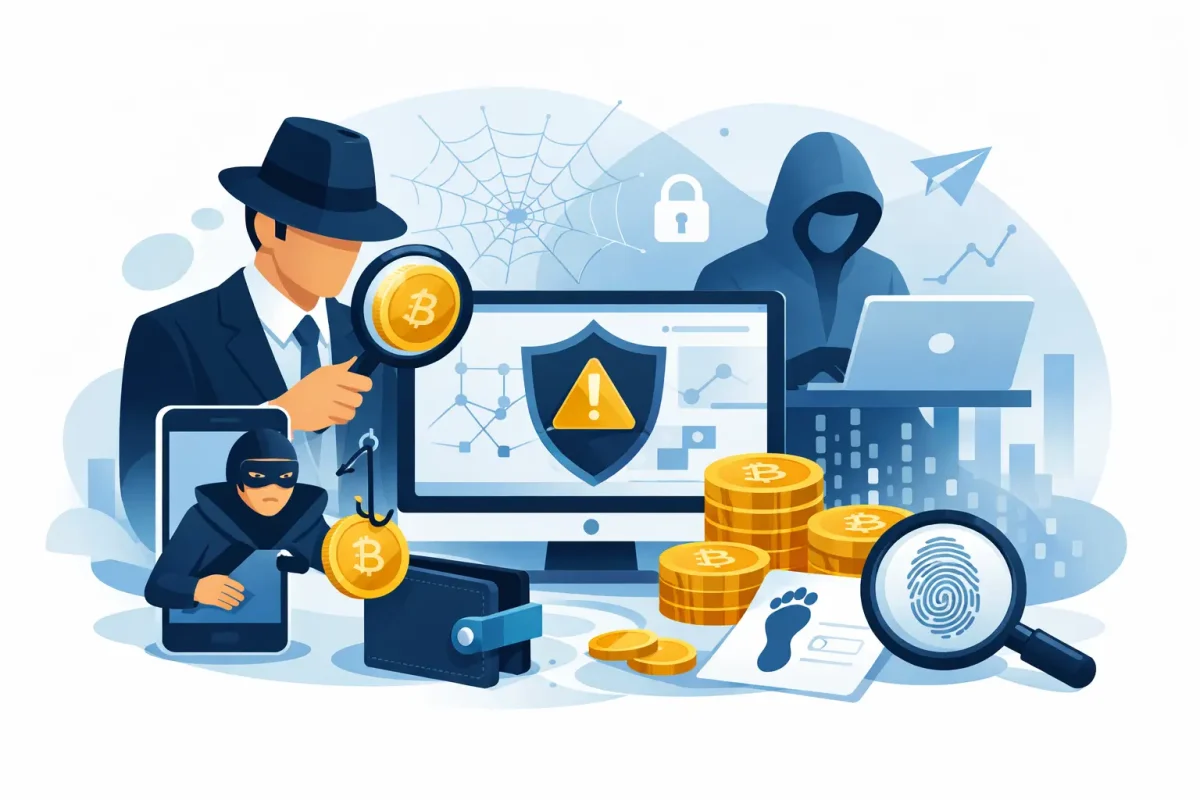
A victim sends funds to what appears to be a legitimate crypto investment platform, sees impressive returns on a dashboard, and then gets blocked the moment they request a withdrawal. By the time they realize the platform was staged, the cryptocurrency scam investigation example is no longer theoretical. It becomes a race to preserve evidence, trace digital movement, and identify whether the funds can still be followed into exchanges, cash-out points, or connected entities.
This is where many people lose time. They assume cryptocurrency fraud is either completely anonymous or instantly recoverable. Neither is true. Some cases leave a clear forensic trail. Others are layered through multiple wallets, swaps, bridges, and offshore platforms. The difference usually comes down to speed, evidence quality, and whether the investigation is built for legal and financial follow-through rather than guesswork.
A cryptocurrency scam investigation example in practice
Consider a common scenario. An individual is approached through social media or a messaging app by someone presenting as a successful trader. Over several weeks, trust is established. The victim is guided to open an account on a professional-looking site that claims to offer crypto trading or staking. They deposit a small amount first, then larger sums after seeing fabricated account growth.
When the victim tries to withdraw, the platform demands an additional payment for taxes, verification, or anti-money laundering clearance. That demand is one of the strongest operational indicators of fraud. Legitimate financial institutions do not require separate crypto payments to unlock existing balances. Once the victim pays again, communication often becomes erratic or stops entirely.
An actual investigation begins by separating appearance from evidence. The platform interface, customer support messages, and reported account balance may all be fictitious. What matters is the underlying transaction activity on-chain and any off-chain records that connect wallets, exchanges, domains, phone numbers, or operators.
What investigators examine first
The first phase is evidence preservation. This sounds basic, but it is often mishandled. Victims may delete chats, lose access to the fake platform, or fail to save wallet addresses and transaction hashes. A proper file should capture screenshots, deposit instructions, email headers, chat exports, payment receipts, blockchain transaction IDs, website URLs, and any identity claims made by the scammer.
Next comes blockchain tracing. If the victim sent Bitcoin, Ethereum, USDT, or another digital asset, investigators map the outgoing transaction and follow subsequent wallet movement. This is not just a matter of looking at a block explorer. Professional tracing involves cluster analysis, behavioral pattern review, time correlation, counterparty identification, and anomaly detection. The goal is to determine whether the funds were consolidated, split, swapped, bridged, or sent toward a service provider that may hold know-your-customer information.
That distinction matters. If stolen funds move into self-custody wallets and remain dormant, the case may require long-term monitoring. If they move into a centralized exchange, there may be a narrower but more actionable window for legal preservation requests, law enforcement referral, or civil process support.
The difference between tracing and recovery
Clients often use these terms interchangeably, but they are not the same. Tracing identifies where funds moved and what entities may be involved. Recovery depends on jurisdiction, timing, available evidence, platform cooperation, and legal strategy. A strong investigation does not promise automatic return of funds. It produces documented intelligence that can support the right next step.
That next step might be a report for counsel, a package for law enforcement, an exchange contact protocol, or a broader asset investigation into related wallets and associated accounts. In some matters, tracing alone changes the case because it disproves a false narrative, identifies a cash-out route, or links multiple victims to the same fraud network.
How the forensic picture develops
In this cryptocurrency scam investigation example, the victim sent USDT on the Tron network to a wallet provided by the fake platform. Investigators identify that the receiving address was not a unique trading account but part of a larger pattern. It had received deposits from numerous unrelated wallets in similar amounts over a compressed period. That behavior is inconsistent with individualized investment management and more consistent with collection infrastructure used in a scam operation.
From there, the wallet transfers funds through a series of hops. Some transfers are small and frequent, intended to fragment the trail. Others are consolidated into a higher-volume address that interacts with exchange-linked wallets. This is where forensic analysis becomes more than simple transaction review. Investigators compare known service exposures, wallet reuse patterns, timing intervals, token movement behavior, and links to previously flagged addresses.
A credible report will note what is confirmed, what is probable, and what remains unresolved. That level of precision matters. Overstating a link can damage a legal matter. Understating it can weaken urgency when action is still possible. The strongest investigative work is technically aggressive but evidentially disciplined.
Off-chain evidence often matters as much as on-chain data
Crypto fraud cases are rarely solved by blockchain review alone. Domain registration details, hosting patterns, platform source similarities, inbound call records, device metadata, and communication logs can all help establish who operated the scheme or how victims were targeted. If the scam involved a fake website, the registration timeline may align with the first outreach to the victim. If the same support email appears across multiple domains, that can indicate a broader fraud architecture.
Financial forensics also comes into play when victims made non-crypto payments before or after the wallet transfer. Wire transfers, card transactions, or bank deposits may connect the digital fraud to real-world beneficiaries, mule accounts, shell companies, or payment processors. In more advanced matters, investigators examine whether the crypto path and fiat path intersect through the same actors.
What a usable investigative report should contain
A professional report is not just a stack of screenshots. It should present a coherent chronology, identify the assets involved, document wallet addresses and transaction hashes, explain the tracing methodology, describe likely service providers encountered, and preserve supporting records in a format suitable for legal or institutional review.
This is particularly important for attorneys, exchanges, compliance teams, and law enforcement contacts. They do not need drama. They need a structured factual record. A weak report creates friction because the recipient must reconstruct the case from fragmented evidence. A strong report shortens that path and improves the odds of meaningful action.
For firms such as Lunar Detective, that usually means combining AI-driven analytics with manual validation. Automation can surface wallet relationships, transaction anomalies, and service exposures quickly. Human forensic review is still essential to test those findings, remove false positives, and translate technical evidence into usable conclusions.
Where cases become difficult
Not every cryptocurrency scam investigation example ends at an exchange wallet. Some funds are moved through decentralized swaps, privacy-oriented services, cross-chain bridges, and nested platforms designed to degrade visibility. Some scammers also stagger movement over weeks or months to reduce attention. Others route funds through jurisdictions where cooperation is limited.
This does not make the case impossible. It changes the strategy. The objective may shift from immediate intervention to intelligence development, wallet monitoring, victim pattern correlation, or support for civil discovery. In certain cases, identifying the network behind the fraud has more value than focusing on a single transaction path.
There is also a timing trade-off. Early action can preserve opportunities, but rushed action without evidence control can create problems. For example, contacting a scammer directly after tracing begins may alert them and trigger faster laundering. Sending incomplete accusations to an exchange may lead nowhere. The right sequence matters.
What victims and counsel should do immediately
The first step is to stop sending money. Scammers frequently demand one more payment for release, tax clearance, insurance, or wallet synchronization. Those are continuation tactics, not solutions. The second step is to preserve everything before accounts disappear or messages are deleted.
The third step is to have the case assessed by an investigator who understands blockchain forensics, financial fraud patterns, and evidentiary reporting. A generic private investigator may miss key wallet indicators or fail to document the case in a way that supports legal action. A purely technical crypto enthusiast may trace transactions but ignore chain-of-custody issues, jurisdictional constraints, or the evidentiary standard needed outside a dashboard.
A serious crypto fraud matter requires both speed and discipline. The useful question is not simply, Can the funds be recovered? It is, What can be documented, who can be identified, where did the assets move, and what action is realistic from here?
That is the value of a real investigation. It replaces panic with structure, speculation with evidence, and false hope with a clear path forward.
